Big Stacy Pool Has Been Naturally Heated Since 1937. The Backup System Is Already Installed.
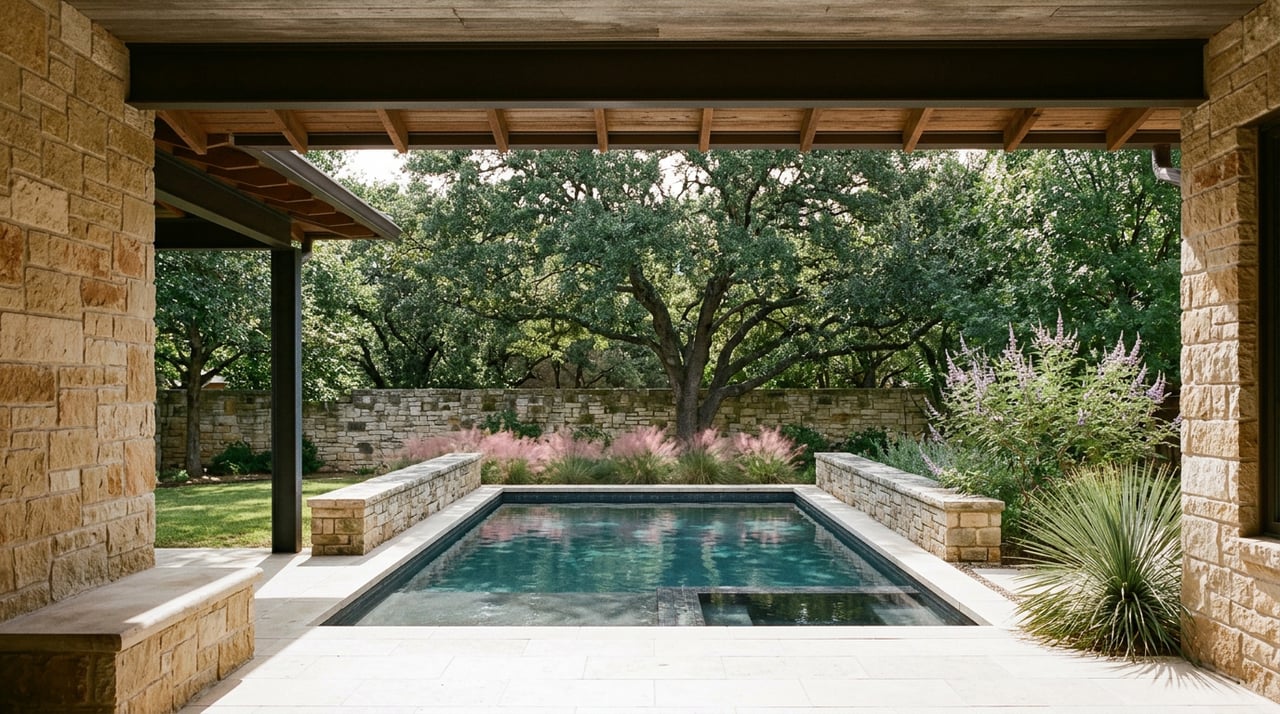
On a January morning, steam lifts off the water at Big Stacy Pool while frost sits on the grass around it. Someone is doing laps in lane four. A couple of regulars stand chest-deep near the shallow end, talking, in no hurry to get out. On the coldest mornings, roughly 50 people a day make this same trip, according to Texas Standard's reporting on the pool. Most of them know the water is warm. Fewer know why, or that the reason is quietly running out.
Big Stacy's heat doesn't come from a boiler or a filtration system the city maintains on a schedule. It comes from a well drilled deep into the ground behind the bathhouse, a well that predates most of the houses around it and that Austin's own aquatics staff say is deteriorating in a way nobody can safely repair. The city has already built what comes next. It just hasn't turned it on yet.
Walk past the lifeguard shed at Big Stacy and there's a door most swimmers never notice, set into the ground behind the pool. Paul Slutes, manager of the City of Austin's Aquatic Division, described it to KUT as the entrance to a geothermal well, drilled when the pool was built to pull warm water up from beneath the surface. A pump moves that water through pipes, where it's filtered and blended into the pool.
The water comes out of the ground hot, somewhere between 90 and 100 degrees. It doesn't stay that hot by the time it reaches swimmers. It mixes with city water on the way in, which is what keeps the pool comfortable instead of scalding, and it's the reason Big Stacy can stay open through winter while most of Austin's outdoor pools shut down for the season.
That system has run more or less the same way since the pool opened. The well hasn't.
Around 2018 or 2019, the city's aquatic division brought in well experts to try cleaning the well with high-frequency sound, a standard maintenance technique. What they found instead was a well whose casing had grown so fragile that cleaning it risked collapsing the whole structure. The experts' advice afterward was blunt: leave it alone.
That's not a repair plan. It's a decision to stop touching something until it fails on its own. A new well is something the city could consider down the road, but there's no funded project or timeline attached to that idea, just an acknowledgment that it's an option.
In the meantime, the backup is already built.
"So we do have heaters now plumbed in, ready to go in case the well does fail." — Paul Slutes, Austin Aquatic Division
Those heaters get tested every year. They have never actually run the pool. The day they do, something changes that has nothing to do with construction and everything to do with what Big Stacy has always been.
The pool won't close. Hours won't shift. The water will still be warm enough for a January lap swim. What ends is the specific thing that made this pool unusual in the first place: heat that comes from the ground for free, rather than heat the city pays for.
| Today, running on the well | After the backup heaters activate | |
|---|---|---|
| Heat source | Geothermal well water, surfacing at 90 to 100 degrees, blended with city water | Gas-fired heaters, already installed and tested annually |
| Cost to keep the pool warm | Effectively free, driven by geology | Up to $10,000 a month, according to Slutes |
| Well's role | Active, though fragile | Retired from service, left in place |
Ten thousand dollars a month is the figure Slutes gave when describing what the city would owe in gas bills if the heaters became the primary system rather than a tested-but-idle backup. That's not a hypothetical line item buried in a budget document. It's the specific cost of replacing something the ground has been doing for nothing since the pool opened.
Big Stacy opened in 1937, built with New Deal money through Franklin Roosevelt's Works Progress Administration. The city added "Big" to the name to distinguish it from the smaller wading pool next door, which became Little Stacy. Both are named for Gen. William Stacy, a Spanish-American War veteran and real estate agent who developed the Travis Heights subdivision in the early 20th century, the same neighborhood whose winding streets and mature oaks still carry his name into local shorthand nearly a century later, per Wikipedia's history of the neighborhood.
That history isn't just trivia. Travis Heights and the adjoining Fairview Park are listed as historic districts on the National Register of Historic Places, and Sarah Marshall, the program coordinator for historic preservation at Austin Parks and Recreation, has said the pool itself, along with its bathhouses and seawall, are contributing structures to that district's historic significance.
Here's the part that doesn't get said out loud very often: that historic designation protects the physical structures. The bathhouses, the seawall, the pool basin itself are recognized and preserved as built landmarks. The geothermal system running underneath all of it isn't a structure in that sense. It's a well, subject to the same physics and the same slow failure as any other well of its age, and no historic listing changes what happens if it gives out.
Big Stacy doesn't function as an isolated destination. It sits inside Big Stacy Park, which connects directly to the Blunn Creek Greenbelt, a stretch that regulars use for leashed dog walks well beyond pool season. Little Stacy Park, with its shallower wading pool for younger kids, sits close enough that families move between the two without getting back in a car.
The pool also runs on its own predictable calendar. It closed for its usual spring cleaning and maintenance window from May 9 through May 17 this year, one of the routine closures the city posts in advance rather than something that catches neighbors off guard. That kind of scheduled, low-drama upkeep is part of what makes the well situation different. Nobody's posting a closure notice for a mechanical system that hasn't failed yet. It's just aging in place, tested once a year, waiting.
Walk a few blocks past the park and you're on South Congress, close enough that plenty of Travis Heights residents treat the whole stretch as an extension of the neighborhood rather than a destination they drive to. The Continental Club has been running music on that strip since 1955. If you haven't tried it yet, The Greek Bar brought Mediterranean plates to East Oltorf, close enough to make it part of a normal week rather than a special trip.
None of that changes because of a well. But it's the same neighborhood logic that makes the pool worth paying attention to in the first place: the things that feel permanent here are usually running on something specific, something that was built once and has been quietly doing its job ever since.
Nobody's suggesting Big Stacy Pool is about to close. It isn't. The city has a working backup plan, tested every year, ready to step in exactly when it needs to. What's worth understanding, if this pool is part of your regular week, is that the warmth itself, the specific thing that makes a January swim here different from anywhere else in the city, isn't guaranteed by the historic designation on the building around it. It's guaranteed by geology that's been running since 1937 and that the city's own experts have already said they can't repair.
That's not a reason to worry about next week. It's a reason to notice what you have while the ground is still doing the work for free.
Travis Heights runs on details like this, the kind that don't show up on a listing sheet but shape what it actually feels like to live here. If you're already part of this neighborhood's routine, or thinking about becoming part of it, the team at Cord Shiflet Group knows these streets well enough to talk about more than square footage. Work with Cord.
Stay up to date on the latest real estate trends.
Relocation
Cord prizes trust. His clients trust him to value and protect their real estate investments. And how’s this for a bonus? He is fun to work with because he loves his work. Whether representing an A-list celebrity or Austin executive, Cord personifies Texas’ entrepreneurial spirit: Play hard. Have fun. Work harder.
CORD SHIFLET
EMAIL US: [email protected]
CALL US: (512) 751-2673
3825 Lake Austin Blvd., #501 Austin, TX 78703