This Is the Month Downtown Austin's Waterfront Finally Connects
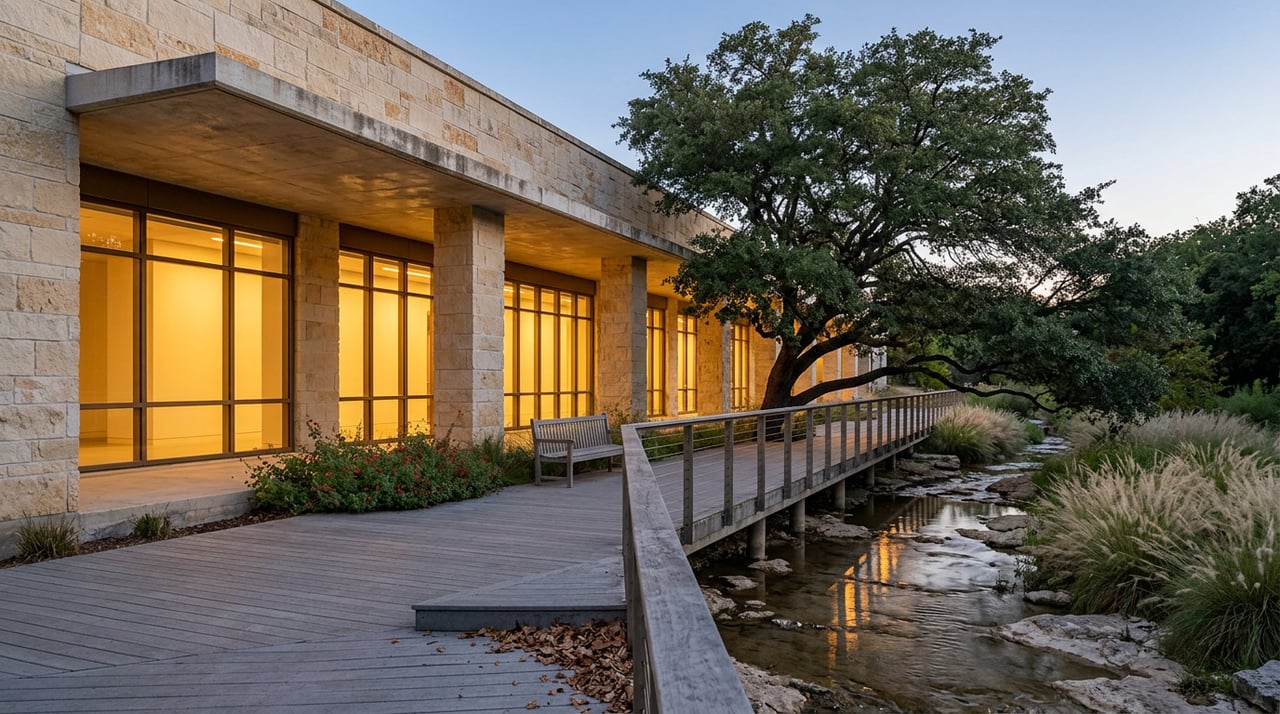
Try walking from the Central Library at Seaholm to a Thursday night table at a sports bar near 3rd Street without crossing Cesar Chavez or Red River on foot. A year ago, you couldn't do it at all. The boardwalk that makes it possible didn't exist yet, and the blocks on either end were still fenced construction sites. Today you can, with the boardwalk open and other pieces of the corridor continuing to take shape around it.
That single fact, easy to miss in the noise of new restaurant openings, is the actual story of downtown Austin this September. Three separate things landed on the same half-mile of waterfront within a few months of each other: a $91.5 million park finished in June, a hotel opened September 3, and a sports club opened September 10. None of them is interesting alone. Together, they mark the moment this corridor stopped being a collection of districts you drove between and became one continuous stretch you can walk end to end.
Waterloo Greenway's second phase, called The Confluence, opened to the public on June 6 after three years of construction along Waller Creek between 4th Street and Lady Bird Lake. The project restored 13 acres along the creek, stabilized banks that had eroded from decades of flood events, planted roughly 1,600 trees and 200,000 native plants, and built three lattice bridges over the water. The detail that matters most for daily foot traffic is the 800-foot boardwalk, engineered specifically to let trail users bypass the intersections at Red River Street and Cesar Chavez Street rather than cross them.
That is the piece that finishes the sentence Waterloo Park started when it opened with the Moody Amphitheater back in 2021. Once Phase III fills in the remaining stretch between 4th and 12th Streets, the greenway will run a full mile and a half from Waterloo Park to Lady Bird Lake without a single at-grade street crossing. The Confluence alone won the Urban Land Institute Austin's 2026 Impact Award for Best Public Place, and it sits exactly at the junction of Palm Park, the Rainey Street Historic District, the Emma S. Barrientos Mexican American Cultural Center, and the Ann and Roy Butler Hike-and-Bike Trail. It is not a park at the edge of downtown. It is the hinge that connects four separate downtown identities into one walk.
The park needed something to anchor each end, and this month it got both.
1 Hotel Austin opened September 3 at 96 Red River Street, occupying the base of Waterline, now the tallest building in Texas at 74 stories, positioned directly beside The Confluence where Waller Creek meets Lady Bird Lake. The 252-room property carries three separate food and beverage spaces that matter more to a resident than a guest. Alteño Austin, led by James Beard-nominated chef Johnny Curiel of Denver's Alma Fonda Fina, serves fire-driven Jalisco Highlands cooking on the ground floor. Sixteen floors up, watr runs a Japanese-leaning rooftop that shifts from daytime brunch to a livelier evening crowd. At street level, Neighbors Café and Wine Bar has its own entrance separate from the hotel lobby, pouring coffee and juice by day and wine and cocktails by night, built for people who are not checking into a room.
A week later, on September 10, Austin Sports Club opened a few blocks away at 205 East 3rd Street. The concept comes from Austin-based Lobos Hospitality, the group behind Powder Room, Toasty Badger, and Manny's, working with Boardroom Hospitality, the venture led by NBA star Kevin Durant and his longtime business partner Rich Kleiman, alongside Airbnb co-founder Joe Gebbia. Rather than another wall-of-televisions sports bar, the roughly 4,700-square-foot space is styled after the American athletic clubs of the 1960s and 70s, with hours that run Monday through Thursday from 5 to 10 p.m., Friday to 11 p.m., and a full Saturday and Sunday schedule that includes brunch starting at 10 a.m.
Two openings, a week apart, on the same corridor that just finished its central park. That timing is worth a resident's attention.
The third piece of this convergence has been building for longer and gets less attention because it looks like ordinary construction cleanup. The Rainey Street Historic District, known for its bars in converted bungalows, has spent the past several years working through a final phase of redevelopment. As of earlier this year, that phase was reported to be roughly 70 percent complete, with expectations of reaching 90 percent by September, this month.
The shift being described is not cosmetic. Developers working in Rainey have been intentional about building what gets called an 18-hour district, a place where you can get coffee in the morning, work from a third space midday, hit the trail by the lake in the afternoon, and still have somewhere to go after dinner, rather than a strip that only turns on after dark. Paseo, a 48-story residential tower on Rainey, opened more than half sold, which is its own signal that the people moving in expect to live there full time rather than visit on weekends.
Put the three threads together and the picture is specific rather than vague. The park that stitches the corridor together finished in June. The two anchor businesses that give people a reason to walk the length of it opened in the first two weeks of September. And the residential district at the southern end of that walk continued through its own redevelopment in the same window.
Here is what the boardwalk buys a resident who was not paying attention to any of this as it happened. Start at Neighbors Café for a coffee before work, walk the new Confluence boardwalk east along Waller Creek past the Lagoon Overlook and Leaf Deck, cross one of the three new lattice bridges instead of waiting for a walk signal, continue onto the Butler Trail toward Rainey, and end the evening a few blocks north at Austin Sports Club for a game without ever touching a crosswalk on Red River or Cesar Chavez. That loop did not exist as a car-free option twelve months ago. It exists now because the boardwalk opened, while other pieces of the corridor continued to take shape between June and September.
If you are hosting out-of-town family this fall, 1 Hotel's rooftop at watr or the ground-floor patio at Alteño gives you a walkable dinner option that did not exist before September, and you can send guests to stay at the hotel itself without anyone needing a car for the weekend.
None of this is finished, and a resident planning a regular route should know where the gap still is. Beginning in June 2026 and continuing through March 2027, the Butler Trail is rerouted on the north shore near The Confluence and the Austin Rowing Club building while Austin Energy installs underground electrical infrastructure along the Lady Bird Lake shoreline between Brazos and Trinity Streets. If your usual loop runs along that specific stretch of the north shore, expect a temporary detour with on-site staff directing traffic for several more months.
The bigger piece still missing is Phase III, the segment between 4th and 12th Streets that will eventually link The Confluence all the way back to Waterloo Park near the university and the Capitol. Until that phase is built, the car-free connection stops at 4th Street rather than running the full mile and a half the project was designed for. What opened this month is real and it is usable today. It is also, by the Conservancy's own account, roughly two-thirds of a longer plan that will keep changing this corridor for another few years.
For now, the honest version of the story is that downtown Austin spent years under construction fencing on three separate fronts, and this month the open boardwalk made a single walk between them possible. Whether you live in Seaholm, on Rainey, or somewhere in between, that walk is the actual news, more than any single restaurant opening on its own would be.
If you are watching how this corridor keeps evolving and want a read on what it means for property here, Cord Shiflet has been tracking West Austin and downtown's connected neighborhoods closely and is glad to talk through what you're seeing on your own block.
Stay up to date on the latest real estate trends.
Relocation
Relocation
Cord prizes trust. His clients trust him to value and protect their real estate investments. And how’s this for a bonus? He is fun to work with because he loves his work. Whether representing an A-list celebrity or Austin executive, Cord personifies Texas’ entrepreneurial spirit: Play hard. Have fun. Work harder.
CORD SHIFLET
EMAIL US: [email protected]
CALL US: (512) 751-2673
3825 Lake Austin Blvd., #501 Austin, TX 78703